Software factories are coming. Funds could be next.
Software factories run coding as a loop of AI agents, with people at the checkpoints. The same pattern is heading into knowledge work, and loan monitoring is one of the first fund workflows built for it.
Hi folks,
This week I'm writing about an idea I keep coming back to: the software factory, and why I think it won't stay in software.
What we're seeing.
Software factories: first code, then the rest of the business
Zach Lloyd runs Warp, a coding tool used by close to a million developers, and he has been pushing the idea of a software factory (Latent Space). Today an engineer sits with an AI assistant and works through a task together. In a factory, a line of AI agents runs the whole loop on its own: pick up the request, write the plan, write the code, review it, test it and ship it. People step in at set checkpoints. Warp says it ships around 2,000 pull requests (proposed code changes) a month this way (How I AI).
The idea is early and still changing. But we keep seeing the same pattern: an AI trend starts in software, because code can be tested automatically, then it moves into knowledge work. Coding agents came first. The same agents now write memos, build models and clean up spreadsheets.
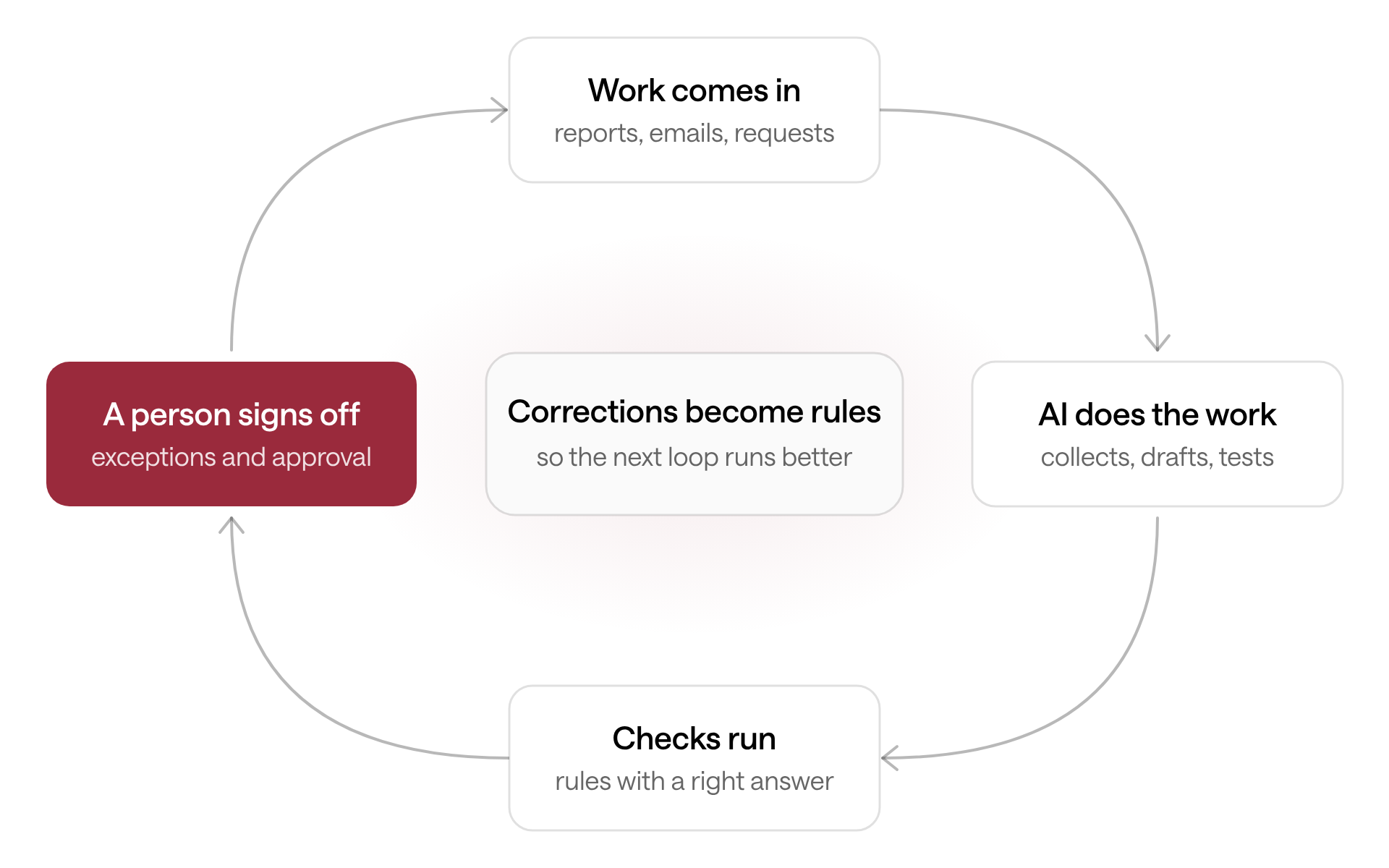
So if software factories are being built, I don't see why we won't eventually have businesses that run like factories. Not robots on a line, but constant loops: work comes in, AI does it, checks run, a person signs off, and the loop runs again.
What this means for a fund:
- Loan monitoring is already a loop. Every month or quarter you collect borrower reporting, test covenants, chase what is missing, flag exceptions and sign off. Most of those steps have a right answer you can check, so it is one of the first fund workflows that can run with a high level of automation. It is where we are spending more and more of our time.
- Your analysts become managers of the AI. The job moves from doing every check to setting the rules, handling exceptions and signing off. When an analyst corrects the AI, that correction becomes a rule for the next run.
- Start with the work you can check. Repetitive, rules based, with a clear right answer. Leave the judgement calls with people for now.
In the mix.
- Anthropic launches Claude Duet, its own personal agent (Reuters)
- Announced on Wednesday as a waitlisted preview for US Pro and Max subscribers. It watches your email, calendar and other connected apps, sends a daily briefing and works on tasks without being asked, checking with you before sensitive actions.
- Our read: this is the trend we wrote about last week. The labs are building the personal agent straight into the apps you already pay for.
- Anthropic's IPO numbers are outstanding (Investing.com, on the WSJ)
- The Wall Street Journal reviewed Anthropic's draft prospectus: first-half revenue of US$16.3bn, up from US$1.1bn a year earlier. It spent nearly US$9bn on computing in the half and has about US$450bn of cloud commitments over the next decade. The US$80.7bn headline loss is mostly non-cash, about US$72bn of it from revaluing convertible notes.
- Our read: almost 15x revenue growth in a year. Businesses are paying for AI that does real work, and paying fast.
- Citi hires a head of "agent factory" (American Banker)
- Citi brought in Sebastian Gnagnarella, who led Gemini Enterprise rollouts at Google Cloud, as head of applied AI and agent factory. Its enterprise AI tools now reach more than 180,000 staff in 87 countries.
- Our read: the factory idea is already on bank org charts. When a bank names a role after it, expect the question to reach funds soon.
Readings.
If you want to double click into things this week I'd recommend:
- How Warp ships 2,000 PRs a month with AI factories, How I AI with Zach Lloyd (Lenny's Newsletter). Claire Vo walks through Warp's setup: requests come in through Slack, are tracked in Linear and come out as tested code changes. The useful bit for anyone outside software is how frankly he says the bottleneck is still human review. That is the same constraint a fund will hit.
We're hiring.
- We're hiring a founding engineer in Melbourne or Sydney to help build these loops for investment firms. If that is you, or someone you know, see the role.

Levercon builds custom, self-improving AI agents and systems for investment firms, with every output traced, verified and signed off.
Book a strategy call.
See where AI fits in your firm.
A short conversation about where AI could help your firm, what to build first, and what it would take.